
GPT-6 Astra & the Future of AVGC-XR in India | AVGC XR Solutions
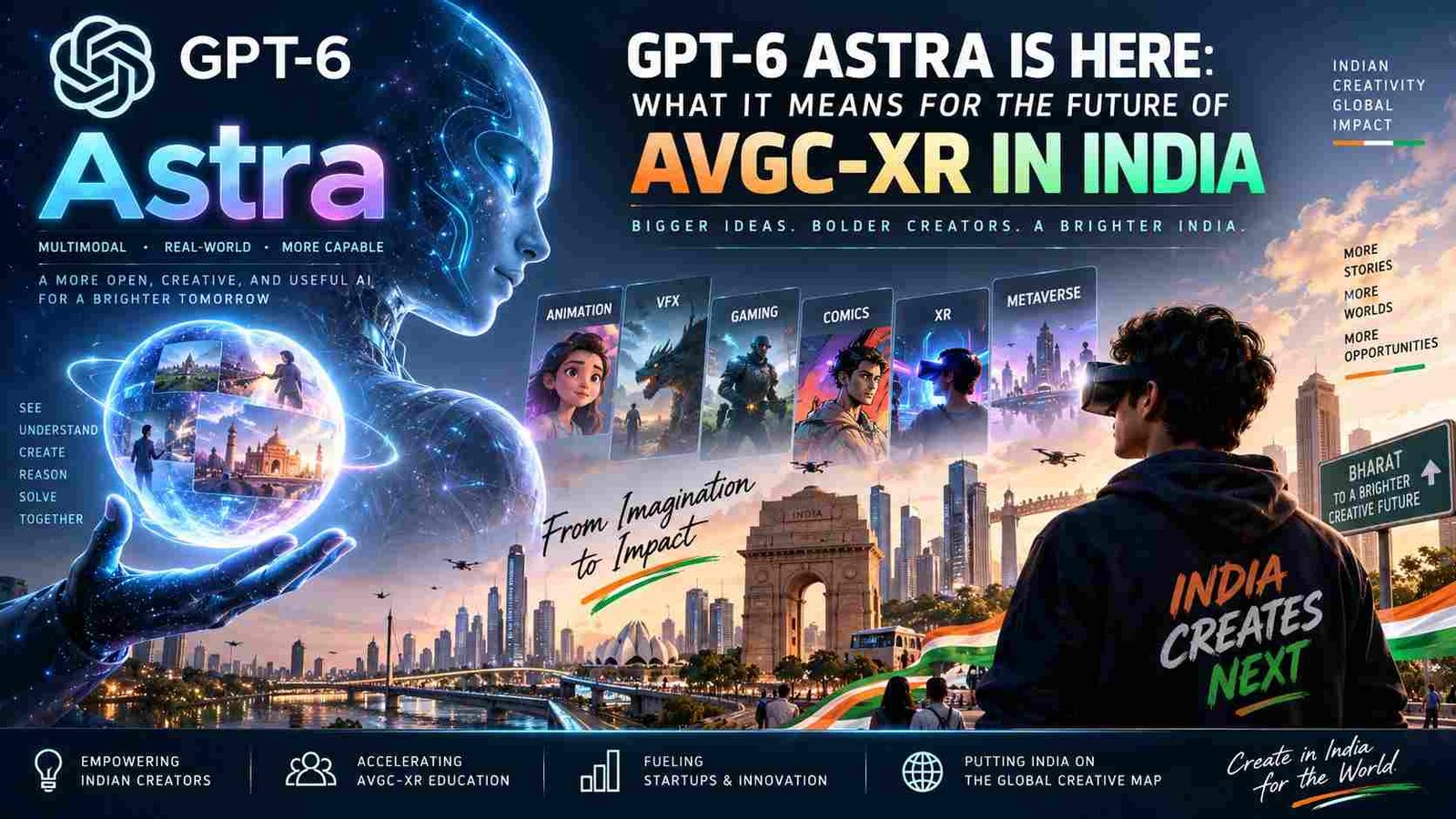
GPT-6 Astra is here. Discover what OpenAI's most advanced model means for India's AVGC-XR sector—and how AVGC XR Solutions is already building for this AI-first future.
GPT-6 Astra Is Here: What It Means for the Future of AVGC-XR in India
On September 3, 2026, OpenAI released GPT-6 Astra — a model it calls the most intelligent and aligned it has ever shipped, with state-of-the-art performance in computer use, software engineering, cybersecurity, and complex professional work. OpenAI President Greg Brockman went as far as suggesting the industry may look back on Astra as the moment the "AGI era" began.
For most industries, this is a headline about a chatbot getting smarter. For India's AVGC-XR sector (Animation, Visual Effects, Gaming, Comics, and Extended Reality) — it is something far bigger: a signal that the tools used to build immersive worlds, animated universes, and next-generation training simulations are about to change permanently. And AVGC XR Solutions, India's first cloud-based AVGC-XR ecosystem, is positioned at exactly the intersection where this shift is happening.
Why an AI Model Launch Matters to the AVGC-XR Industry
At first glance, a large language model and a VFX pipeline seem unrelated. But look closer at what GPT-6 Astra is actually built for, and the overlap with AVGC-XR workflows becomes obvious:
- Computer use and agentic workflows — Astra can navigate software interfaces, fill forms, and operate multi-step tools with far less human guidance. For animation and VFX studios, this points toward AI systems that can operate inside production software (rigging, compositing, asset management) rather than just generating a static image or line of code.
- Advanced software engineering — Game development, real-time 3D engines (Unity, Unreal Engine), and WebXR applications are fundamentally software products. A model this capable at engineering tasks accelerates prototyping cycles for game studios and XR app developers across India.
- Scientific and professional-grade reasoning — This directly benefits the Research side of AVGC-XR: simulation accuracy, physics-based rendering, and next-gen haptic or spatial-computing research all lean on the kind of frontier reasoning Astra demonstrates.
- Cybersecurity capability — As AVGC-XR platforms move deeper into government, defense, and smart-city work (digital twins, e-governance interfaces, defense simulations), models that meet a "Critical" cybersecurity threshold under OpenAI's own framework raise the stakes — and the opportunity — for secure, compliant immersive systems built in India.
In short: the arrival of frontier models like GPT-6 Astra doesn't compete with AVGC-XR — it compounds it. Studios, trainers, researchers, and educators who learn to build with these models, not just alongside them, will define the next phase of India's Orange Economy.
Where AVGC XR Solutions Fits Into This AI-Driven Future
AVGC XR Solutions was built on the idea of "Eight disciplines. One vision." — Animation, VFX, Gaming, Comics, Extended Reality, and Research unified into a single cloud-based ecosystem, as outlined in our story. That structure is precisely what's needed to absorb a shift as large as GPT-6 Astra's release. Here's how each pillar responds to this moment:
AVGC XR Solutions Studio Division: AI-Augmented Production Pipelines
The Studio arm runs production pipelines across every core AVGC-XR discipline — 2D animation, 3D animation, comic design, communication design, and game development — for B2B clients. As agentic AI models take over repetitive production tasks — rotoscoping, asset tagging, first-pass compositing — studios that build this directly into their AI generation workflows (rather than treating AI as a separate experiment) will deliver faster turnarounds without sacrificing the creative direction that still requires a human eye. On the XR side, the immersive design service is where this shift shows up most directly — AR/VR/MR experiences that increasingly rely on AI-assisted asset generation and real-time scene logic. Anything outside these named tracks — from motion graphics to bespoke production needs — falls under other Studio services, backed by the 500+ strong production team behind every delivery.
AVGC XR Training Academy: Preparing Talent for an AI-First Toolchain
Every leap in foundation models resets the skill bar for creators. The Training arm focuses on industry-ready skill development programs — and "industry-ready" today increasingly means fluency in AI-assisted animation, procedural generation, and prompt-driven asset creation alongside traditional craft. As GPT-6 Astra and similar models get embedded into creative software, the professionals who complete AVGC XR Solutions' skill development courses — learning to direct these tools rather than just use them passively — will be the most employable talent in the sector.
AVGC XR Solutions Academic Division: Curriculum That Keeps Pace With the Frontier
Foundation model releases happen faster than most academic curricula can update. The Academic arm works with educational institutions across several fronts: curriculum design that builds AI literacy and model-assisted design thinking directly into AVGC-XR courses before they become outdated, workshops that expose students to frontier tools like GPT-6 Astra hands-on, and faculty training that keeps teaching staff current with the same AI-assisted production tools their students will use in industry. On the institutional side, BOS advisory support helps academic boards formally update syllabi to reflect this shift, the FLP program supports the next layer of academic-industry alignment, and infrastructure support ensures campuses actually have the lab and compute setup to run AI-integrated coursework. And because none of this matters if graduates can't find relevant jobs, hiring & placement support connects AI-literate AVGC-XR talent directly to studios and employers looking for exactly that skill set. This full academic ecosystem aligns directly with the goals of the National AVGC-XR Mission to build a future-ready talent pipeline.
AVGC XR Solutions Research Division: Frontier XR Meets Frontier AI
The Research arm explores frontier VR/AR/MR technologies driving the Orange Economy. Models like GPT-6 Astra — with stronger scientific reasoning and simulation capability — open new research directions: smarter physics simulation for VR training, AI-assisted digital twins for smart cities, and more sophisticated defense/government simulation systems. Frontier AI and frontier XR research are converging, and this is where AVGC XR Solutions' sustained R&D investment pays off.
Together, these four pillars are what let AVGC XR Solutions respond to a shift like GPT-6 Astra as one connected ecosystem rather than four separate teams reacting in isolation — explore more of this thinking on the AVGC XR Solutions blog.
GPT-6 Astra in Action: Use Cases Across the AVGC-XR Sector
Beyond the concept-level shift, here's what Astra-class AI actually looks like when applied inside real AVGC-XR workflows:
1. Animation & VFX Studios — Agentic Production Assistants
Instead of a human artist manually tagging thousands of frames or setting up repetitive compositing layers, an Astra-level model can operate directly inside production software — running multi-step tasks like batch rotoscoping, asset organization, and first-pass color correction with minimal supervision. Example: a mid-size animation studio uses an Astra-powered agent to auto-generate rough in-between frames for a 2D animation sequence, cutting first-draft turnaround from days to hours, while animators focus on final polish — the same principle applies to 3D animation pipelines using AI-assisted rendering passes.
2. Game Development — Faster Prototyping in Unity/Unreal
Astra's software engineering strength translates into faster iteration for game studios. Example: a game development team building a mobile title in Unity uses Astra to auto-generate and debug gameplay scripts, physics interactions, and UI logic — compressing a typical two-week prototyping sprint into a few days, so more design time goes into actual gameplay feel.
3. XR Training & Simulation — Smarter Scenario Generation
For VR/AR training modules (corporate onboarding, industrial safety, medical training), Astra's reasoning can generate branching training scenarios and realistic decision-trees automatically. Example: a VR firefighter training simulation — built the way AVGC XR Solutions approaches immersive design — uses an Astra-driven system to dynamically generate new emergency scenarios based on trainee performance, instead of relying on a fixed set of pre-scripted situations.
4. Government & Defense — Secure Digital Twins and Simulation
Because Astra meets a "Critical" cybersecurity threshold under OpenAI's own framework, it's relevant to sensitive simulation work. Example: a smart-city digital twin project uses Astra-class reasoning to model traffic and emergency-response scenarios in real time, while the same underlying cybersecurity rigor helps evaluate the platform's resilience against intrusion — a requirement for any defense-adjacent or e-governance deployment.
5. Academic & Research — AI-Assisted XR Research
On the research side, Astra's scientific reasoning can support physics-based rendering research and spatial computing experiments. Example: a university research partnership — supported by the kind of curriculum and infrastructure collaboration AVGC XR Solutions offers institutions — uses Astra to run rapid simulations of haptic feedback models for a new VR interface, testing dozens of parameter variations in the time it used to take to test a handful manually.
6. B2C / Consumer XR — Personalized Immersive Content
For consumer-facing AR/VR apps, Astra-style agentic capability enables more personalized, real-time content generation. Example: an AR try-on app dynamically adjusts product recommendations and virtual fitting based on a user's real-time interactions, rather than relying on static pre-rendered options.
These aren't hypothetical futures — they're the direction production pipelines, training programs, research labs, and consumer XR products are already moving, and it's exactly the range AVGC XR Solutions' four-pillar model is built to support.
What This Means for India's Orange Economy
India's AVGC sector is targeting a $40 billion vision by 2030, backed by the National AVGC-XR Mission, NASSCOM's AVGC Forum, and growing state-level investment. The release of frontier models like GPT-6 Astra doesn't threaten that trajectory — it raises the ceiling on what Indian AVGC-XR companies can deliver to global clients, at India's well-established cost advantage of 60–70% savings compared to US/EU studios.
Companies that treat AI model launches as operational signals — not just tech news — will be the ones setting the pace for India's immersive content and gaming exports over the next five years. AVGC XR Solutions is structured, across all four pillars, to be one of them.
Frequently Asked Questions
Q: How does an AI model like GPT-6 Astra actually affect animation and VFX work? A: Frontier models increasingly handle software-navigation and repetitive production tasks — asset tagging, rough compositing, code-assisted rigging — freeing studio teams to focus on creative direction, storytelling, and final-quality control rather than manual repetitive work.
Q: Will AI models like GPT-6 Astra replace jobs in India's AVGC-XR sector? A: The bigger shift is a change in required skills, not a removal of jobs. Professionals who can direct AI tools within animation, gaming, and XR pipelines — rather than compete with them — are positioned to become more valuable, not less.
Q: How is AVGC XR Solutions preparing for AI-driven changes in the AVGC-XR industry? A: Through its four-pillar model — Studio, Training, Academic, and Research — AVGC XR Solutions is building AI-aware production workflows, updating training curricula for AI-assisted creative tools, partnering with institutions on future-ready coursework, and researching where frontier AI and XR/AR/MR technology intersect.
Q: What is the National AVGC-XR Mission and how does it relate to AI adoption? A: The National AVGC-XR Mission is India's government-backed initiative to build the country into a global AVGC-XR hub. As AI models transform creative and technical workflows, the Mission's goals around skill development and studio capability building become even more relevant to how Indian companies adopt these tools.
Ready to Build for the Next Wave of AVGC-XR?
Whether you're a studio exploring AI-augmented production, an institution updating your curriculum, or a government body evaluating next-gen simulation systems — AVGC XR Solutions' four pillars are built for what comes after models like GPT-6 Astra.
Blog Written by
Durgesh Pandey