
Design Patents for Design Schools & the AVGC-XR Sector | AVGC XR Solutions
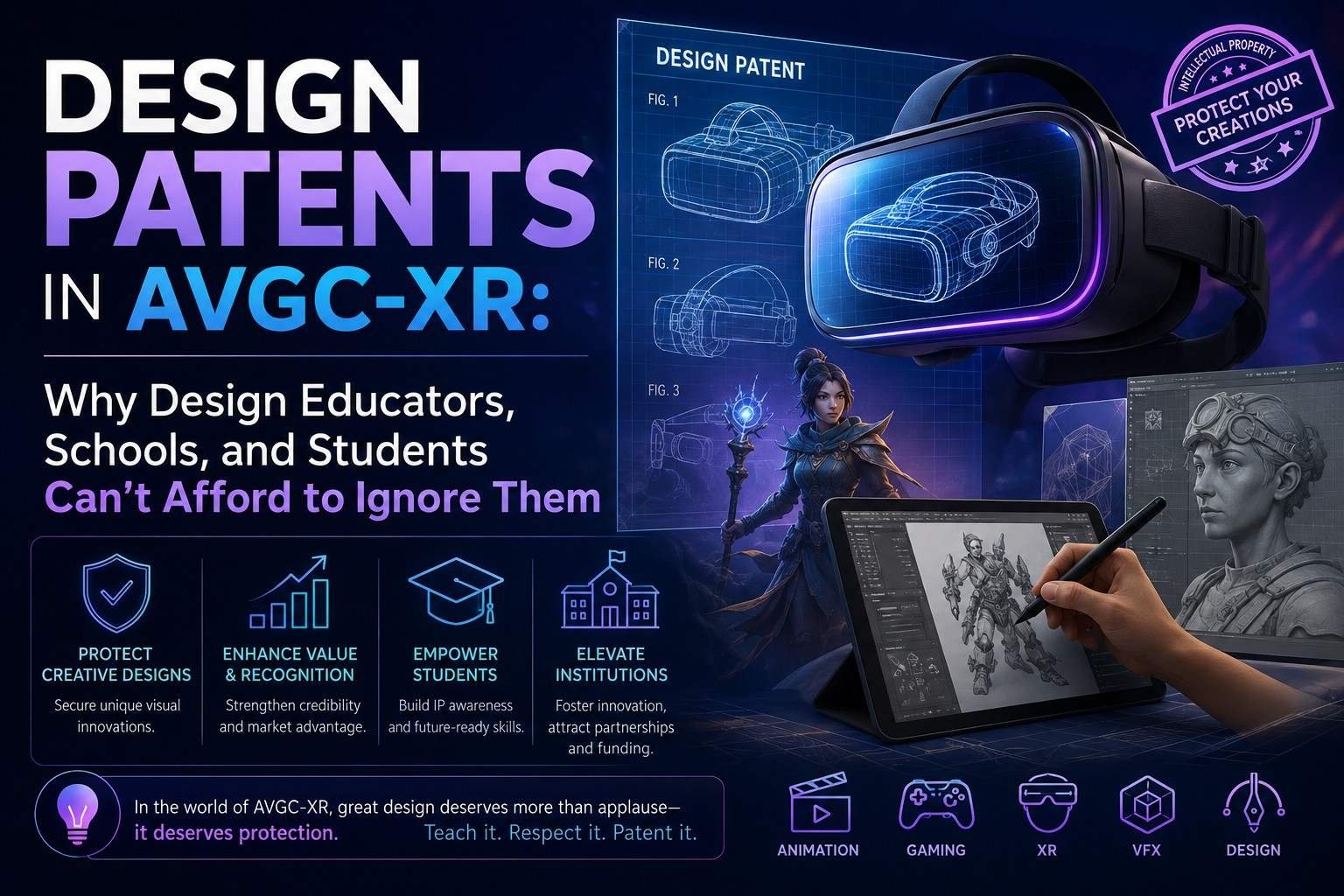
Why design patents matter for design educators, students & India's AVGC-XR sector, and how AVGC XR Solutions' research division helps protect original design work.
Design Patents in AVGC-XR: Why Design Educators, Schools, and Students Can't Afford to Ignore Them
Every semester, design schools across India send thousands of original concepts into the world—character designs, game assets, product forms, UI interaction patterns, wearable XR hardware shells, and ornamental interfaces. Almost none of it gets protected. In a sector built entirely on original visual and experiential design, that's a gap that costs creators, institutions, and the country's creative economy real value.
As India's AVGC-XR sector (Animation, Visual Effects, Gaming, Comics, and Extended Reality) scales under the National AVGC-XR Mission, design patents—known formally in India as design registration under the Designs Act, 2000—are becoming as important to a design education as portfolio-building itself. AVGC XR Solutions, through its dedicated research pillar, is working to close this gap for design educators, design schools, and students across the Orange Economy.
What Is a Design Patent or Design Registration, Exactly?
The term "design patent" is widely used internationally (particularly in the US), but in India, the equivalent protection is a registered design under the Designs Act, 2000, administered by the Office of the Controller General of Patents, Designs and Trademarks (CGPDTM).
A design registration protects the visual and ornamental features of an article—its shape, configuration, pattern, ornamentation, or composition of lines and colors—as applied to a finished product. It does not protect function (that's a utility patent's job) or pure artistic works with no industrial application (that's copyright's job). For the AVGC-XR sector, this matters because so much of the sector's output sits exactly at that intersection: a game controller's form factor, an XR headset's shell, a stylised character silhouette applied to merchandise, or a distinctive UI icon set used across a product line.
Why This Matters for Design Educators and Design Schools
Design schools train the next generation of creators who will originate exactly this kind of work — yet design law is rarely part of the curriculum. That creates three recurring problems:
- Students graduate without knowing their work is protectable. A capstone project's product design or character IP often has real commercial value the student never registers.
- Institutions lose out on IP credibility. Design schools that can point to filed or granted design registrations from student and faculty work build stronger placement records, stronger industry partnerships, and stronger NIRF/accreditation IP metrics.
- Faculty research goes undocumented. Original ornamental design work developed during funded research projects—VR interface design, product-form studies, and immersive hardware concepts — needs to be captured and filed before it's published or shown publicly, since public disclosure can jeopardise registrability.
Building design-patent literacy into studio courses, thesis guidance, and research cells gives design schools a durable, teachable IP advantage — not just a legal formality.
Why It Matters for the Entire AVGC-XR Sector
Design registration isn't a niche legal topic for the AVGC-XR sector—it touches nearly every discipline inside it:
- Gaming: controller ergonomics, UI iconography, distinctive character silhouettes used on merchandise and packaging
- Animation & Comics: stylised character forms and visual motifs applied to physical or licensed products
- XR/AR/VR: headset and wearable form factors, spatial interface layouts, haptic device shells
- Studio production: any physical prop, set element, or product mockup built for a client with commercial intent
As India pushes toward its $40B AVGC vision by 2030, more of this output is being commercialized, licensed, and exported. Unregistered design work is easy to copy and hard to defend — a real risk for studios competing globally and for India's broader Orange Economy ambitions.
How AVGC XR Solutions' Research Division Helps
AVGC XR Solutions was built as "Eight disciplines. One vision" —Animation, Visual Effects, Gaming, Comics, Extended Reality, and Research unified into one cloud-based ecosystem. The research pillar exists specifically to explore frontier VR/AR/MR work and translate it into value for the wider Orange Economy—and that includes helping educators, schools, students, and studios understand and pursue design protection for original work.
Through its research division, AVGC XR Solutions supports the design education and AVGC-XR community by:
- Design-patent awareness workshops for design educators and students, explaining what qualifies for design registration in an AVGC-XR context (character forms, product shells, UI layouts, XR hardware design)
- Academic collaboration with design schools (via the Academic pillar) to build IP literacy into studio curricula and thesis review processes
- Research documentation support for original ornamental and interface design work coming out of student projects, faculty research, and studio production—helping teams capture registrable design work before public disclosure
- Guidance on the registration pathway — connecting design educators, students, and studios with the right process and next steps for filing under the Designs Act, 2000
This isn't a generic legal add-on—it's part of AVGC XR Solutions' broader mission to convert original creative and research output across the AVGC-XR ecosystem into protected, commercially defensible IP.
Explore AVGC XR Solutions' Research pillar → research.avgcxrsolutions.com
See how Academic partnerships work → academic.avgcxrsolutions.com
Building an IP-Aware Design Education, One Cohort at a Time
Design schools that treat design registration as a core studio course skill—not an afterthought—send graduates into the AVGC-XR sector who protect their work from day one. For an industry racing toward India's AVGC-XR Mission targets, that shift in mindset, starting in the classroom, is what turns individual creativity into lasting institutional and national IP value.
Ready to bring design-patent literacy into your design school or studio? AVGC XR Solutions' Research division works with design educators, institutions, and AVGC-XR studios across India to build this capability. Start Your Journey →
Frequently Asked Questions
Is a "design patent" the same as a design registration in India? Functionally, yes. "Design patent" is the common US term; in India, the equivalent protection is called a "registered design" under the Designs Act, 2000, filed with the Controller General of Patents, Designs, and Trade Marks.
Can a student's college project be design-registered? Yes, provided the design is new, original, and hasn't been publicly disclosed (published, exhibited, or sold) before filing. This is why capturing design work early — before showcases or portfolio publishing — matters for design students.
What kinds of AVGC-XR work can get design protection? Ornamental and visual elements with industrial application — think game controller shapes, XR headset shells, character silhouettes used on merchandise, and distinctive UI/interface layouts — can qualify, as long as they meet the novelty and non-disclosure requirements.
How is this different from copyright, which already protects creative work? Copyright protects the artistic expression itself (a drawing, a 3D model file). Design registration protects the ornamental/visual design as applied to an article that will be produced or sold. Many AVGC-XR outputs benefit from both types of protection working together.
How can a design school get started with AVGC XR Solutions' Research division? Institutions can reach out via the contact page to discuss workshops, academic collaboration, and research documentation support tailored to their design programs.