
Comics Industry: A Missing Fourth Pillar of the AVGC XR Policy
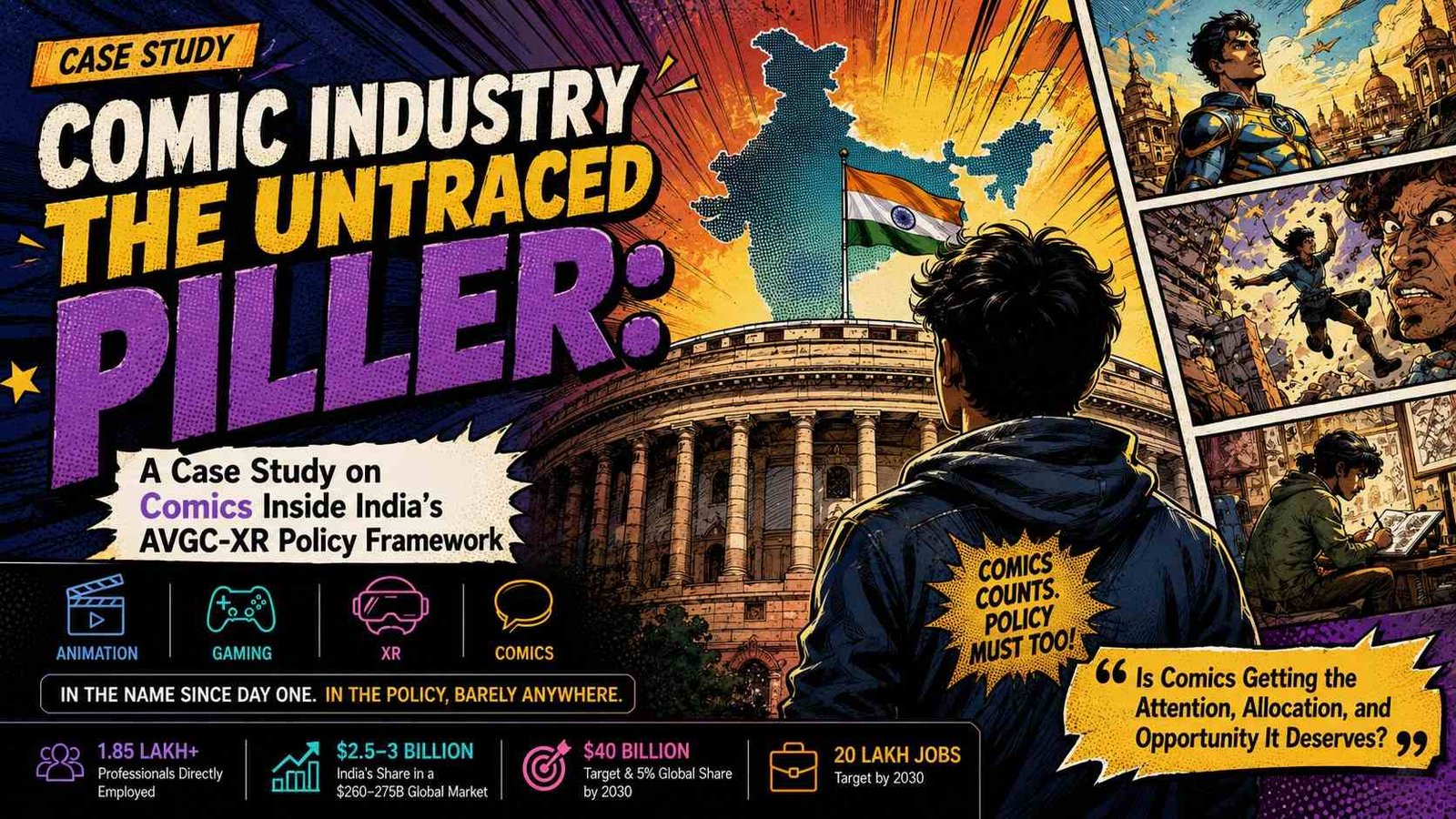
A policy-by-policy, data-backed case study across six national and state AVGC-XR instruments—and India's comics readership—showing why comics have no market data, no scheme, and no training pipeline.
The Untracked Pillar: A Case Study on Comics Inside India's AVGC-XR Policy Framework
Scope of this study: This piece examines every major AVGC-XR policy instrument in India — the national Task Force framework, the National Centre of Excellence, and five state policies (Karnataka, Tamil Nadu, Maharashtra, Madhya Pradesh, and Delhi's policy-in-formulation) — plus the demographic data available on India's comics audience, and checks one specific question against each: does comics get a named allocation, facility, program, or study, the way animation, gaming, and XR do? The answer, almost everywhere, is no. What follows is the evidence, instrument by instrument, and what a service provider can do about the gap it exposes.
1. Background: Comics Has Been in the Name Since Day One
The sector's founding document — the AVGC Promotion Task Force, constituted by the Ministry of Information & Broadcasting in April 2022 and chaired by then-Secretary Apurva Chandra — was never called an "Animation Task Force" or a "Gaming Task Force." Its full title was the Animation, Visual Effects, Gaming and Comics (AVGC) Promotion Task Force, submitting its report "Realising AVGC-XR Sector Potential in India" on December 22, 2022. Comics was written into the sector's identity at the very first policy document — not added later as an afterthought.
The report's own numbers tell an oddly incomplete story. It counted 1.85 lakh professionals directly employed in the sector, with roughly 30,000 more employed indirectly, and pegged India's slice of the global AVGC pie at $2.5–3 billion out of a $260–275 billion worldwide market — a sliver worth chasing hard, which is exactly why the report set its sights on $40 billion and a 5% global share, riding 25–30% annual growth toward 20 lakh jobs by 2030. Ambitious numbers, confidently stated. What's missing is any breakdown of which of the four disciplines those jobs and dollars actually sit in. Gaming and animation/VFX each get their own independent tracking series today — Statista, EY-FICCI, Niko Partners, Lumikai all publish discipline-specific numbers. Comics has never had one. It's in the sector's name, in the report's title, and nowhere in its data tables.
2. Methodology: Checking Comics Against Every Major Policy Instrument
To test whether this is a genuine gap rather than a one-off omission, this case study checked comics-specific provisions against the policy instruments currently most advanced in India's AVGC-XR ecosystem — one national framework, the national Centre of Excellence, and five state policies.
A. National Centre of Excellence (NCoE / IIIC), Mumbai
Cabinet-approved in September 2024, the NCoE — provisionally named the Indian Institute for Immersive Creators — is still finding its feet. As of early 2026, the Indian Institute of Creative Technologies (IICT) has been designated the nodal agency, and stakeholder consultations on the technology stack and beneficiary institutions are underway roughly 18 months after approval. Its mandate is generous on paper: IP creation "based on India's rich historical and cultural heritage," broad enough to comfortably cover comics. But in practice, animation and gaming pipelines are already what's shaping the Centre's planning conversations, and no comics-specific curriculum, lab, or funding track has been named alongside them. [INTERNAL LINK: research.avgcxrsolutions.com — anchor: "AVGC-XR research and IP development"]
B. Karnataka AVGC-XR Policy 3.0 (2024–2029)
Karnataka isn't new to this — Policy 3.0 is its third AVGC-XR policy since 2012, and the state was the first in India to stand up a dedicated AVGC Centre of Excellence. The numbers behind it are substantial: a ₹150 crore allocation for FY 2024-25, a target of 30,000 new jobs by 2028, and an ambition that 80% of sector revenue come from exports. On the ground, that's already translated into Digital Art Centers across 27 colleges reaching 400 students, plus an AVGC finishing school that has put 842 students through training — building on a base where Karnataka already claims 20% of India's M&E industry and hosts 300+ specialized studios. The policy is organized around six pillars — skilling, infrastructure, startups and MSMEs, global market access, financial incentives, and mobile-first products — and every one of them is written in discipline-neutral language. But look at what actually got built: Digital Art Centers, a finishing-school curriculum, and an AVGC Fund that's so far backed two startups, all oriented toward animation, gaming, and mobile products. Nothing in the public documentation carves out a comics-specific facility, incentive slab, or startup category. [INTERNAL LINK: training.avgcxrsolutions.com — anchor: "comics and illustration training programs"]
C. Tamil Nadu AVGC-XR Policy 2026
The newest entrant, notified in March 2026, and arguably the most aggressively funded. Its centerpiece is the ₹50 crore ELCOT Viyan AVGC-XR Centre of Excellence in Chennai, backed by a ₹250 crore R&D fund and startup grants running up to ₹1 crore each — all in service of a target of 200+ startups and roughly 20% of India's AVGC-XR market by 2030, translating to an estimated 2 lakh jobs. The CoE's first phase brings a performance-capture studio, an XR testing lab, hardware-rental facilities, and an immersive writer's room; its second phase adds a vocational education centre, a photogrammetry studio, audio/foley services, 2D/3D art studios, and QA facilities. That second-phase list is the closest any policy in this study comes to naming something comics-adjacent — "2D/3D art studios" — and even there, comics or sequential-art production doesn't get called out as its own service line the way performance-capture, XR testing, and audio/foley each do.
D. Maharashtra AVGC-XR Policy 2025
If Tamil Nadu is the newest, Maharashtra is the biggest. Approved in September 2025 with a 25-year horizon stretching to 2050, the policy commits ₹3,268 crore total — ₹306 crore over the first five years, ₹1,960 crore over the following twenty — with ₹100 crore earmarked for FY 2025-26 alone. The ambition attached to that spending is considerable: ₹50,000 crore in investment, 2 lakh high-tech jobs, and growth of the state's AVGC-XR sector turnover from its current ₹25,000 crore to a targeted ₹65,000 crore within five years. Maharashtra already has scale to build on — 295+ studios, roughly 30% of India's total — and backs the ambition with a ₹200 crore WAVES Participation Fund and a ₹300 crore Start-up Fund, plus named AVGC parks in Mumbai and Pune, virtual production facilities, testing labs, and clusters reaching into tier-2/3 cities like Nashik, Nagpur, Kolhapur, Satara, and Chhatrapati Sambhajinagar. The policy explicitly names production incentives and school-integrated skill-training for "gaming, animation, VFX, and XR creators." Comics doesn't make that list — despite being part of the policy's own name.
E. Madhya Pradesh AVGC-XR Policy 2025
Launched at WAVES 2025 alongside the state's Film Tourism Policy, MP's AVGC-XR Policy targets ₹2,000 crore in investment, positioned to "support pre- and post-production and also promote related sectors like animation, gaming, and VFX." The pattern repeats exactly: comics isn't named among the sectors the policy singles out for promotion.
F. Delhi's AVGC-XR Policy (in formulation) — the Home State of This Analysis
Here's where the pattern breaks — not because comics got included, but because the door is still open. As of January 2026, Delhi announced it's formulating its own AVGC-XR policy and will host a regional centre of the National Centre of Excellence for immersive technologies — the first such regional NCoE extension anywhere outside Mumbai. Chief Minister Rekha Gupta said the government is studying Maharashtra's framework to adapt one suited to Delhi. Unlike Karnataka, Tamil Nadu, Maharashtra, and Madhya Pradesh — where the policy text is already locked and the comics gap already baked in — Delhi's policy hasn't been written yet. Whether comics gets named infrastructure in the capital is still an open, undecided question. [INTERNAL LINK: avgcxrsolutions.com/our-story.html — anchor: "AVGC XR Solutions, Delhi"]
G. Other States With Dedicated AVGC-XR Policies
Beyond the five examined in detail, more than ten Indian states have introduced dedicated AVGC-XR policies with their own incentives and infrastructure, including Telangana, Rajasthan, Kerala, and West Bengal. Public summaries of these policies follow the same national AVGC-XR umbrella language as Karnataka and Maharashtra — and none surfaces a distinct comics allocation in any published policy document reviewed for this study.
3. Findings: The Pattern Across Every Instrument Examined
Line them all up and the picture is stark. The national Task Force names comics in its title but gives it no facility and no training track. The NCoE's mandate could stretch to cover comics but hasn't named anything for it yet. Karnataka, Tamil Nadu, Maharashtra, and Madhya Pradesh all fold comics into the "AVGC-XR" umbrella in their policy names — and all four skip it entirely when the money and the buildings get allocated. Delhi is the single exception, and only because its policy doesn't exist yet to have made the same omission.
That's six finalized policy instruments, spanning national and four different state governments, producing the identical result: comics is named in the sector's identity everywhere, but has zero dedicated infrastructure, funding line, or training pathway anywhere the decision has already been made. This isn't scattered underfunding — it's a pattern that repeats with almost mechanical consistency every time a new policy gets written.
4. Corroborating Signal: Demand Exists Even Without Data
If comics had no real market activity, the absence of tracking would be unsurprising. The available proxy evidence suggests otherwise. Comic Con India has been running since 2011, growing from a single Delhi event into an eight-city annual circuit spanning Delhi, Mumbai, Bangalore, Pune, Hyderabad, Ahmedabad, Chennai, and Kolkata. By 2017, just the four founding cities pulled a combined 200,000 attendees. More tellingly, the Hyderabad edition — a city that joined the circuit later — drew over 40,000 attendees in its most recent season on its own. Layer onto that a parallel webtoon and digital-comics creator economy that's grown organically on Instagram, Webtoon, and Tapas, generating real income for creators entirely outside any formal registration or revenue-reporting channel that feeds into the Task Force's official employment and revenue figures.
This is almost exactly the shape gaming had roughly a decade ago: real, growing consumer demand running well ahead of any formal tracking infrastructure, until dedicated market-research coverage from Lumikai, Niko Partners, and Statista eventually caught up to it. Comics looks to be sitting at that same pre-formalization stage right now.
5. Demographics: Who Reads and Creates Comics in India — and Why Even This Is Hard to Answer
The demographic picture suffers from the exact same blind spot as the funding picture. India has no dedicated, government- or industry-run survey of who its comics readers and creators actually are — nothing like the age and gender breakdowns Lumikai and Niko Partners routinely publish for gaming, or that Statista and Publishing Perspectives track for general book readership. So the best available picture has to be pieced together from what's adjacent and international.
Start with general reading habits: post-lockdown surveys show readers 34 and under make up the larger share of India's print readership, while readers 35 and older over-index on e-books — a reasonable proxy that India's digital-comics audience likely skews the same young direction print does. Widen the lens globally, and the pattern gets sharper: Webtoon, the world's largest digital comics platform, reports that more than half of its 82 million monthly users are women, with growth driven overwhelmingly by readers under 25 scrolling comics on their phones rather than buying them in print. India-specific platforms are already betting on exactly that audience — Graphic India's Toonsutra launched as a webtoon platform built around Indian IP, including stories drawing on properties like Baahubali and The Legend of Hanuman, chasing the same mobile-first, youth-skewed readership that's made top Asian webtoon platforms reach a combined 70 million-plus monthly users. Even Comic Con India's own crowd — drawn heavily from cosplay, anime, and fandom communities — points the same direction: young, mobile-native, digitally engaged, consistent with the global pattern even though no India-specific study confirms it directly.
The honest takeaway mirrors the policy finding almost exactly: the demand signal is real and points toward a young, mobile-first, increasingly female audience — but no Indian institution, government or industry, currently measures it directly. Any business or policy decision about comics in India today is necessarily being made on proxy data, not a dedicated study.
6. Why the Gap Matters: The IP Pipeline Problem
The Task Force's "Create in India" recommendation — building original, exportable Indian IP rather than continuing as a production-for-hire hub — depends on a source-material layer underneath it. Globally, comics have historically been the cheap, fast testing ground where characters and story-worlds get proven out before anyone commits an animation or game-development budget to them; Marvel, DC, and most major anime franchises all started this way. India's policy framework, as the six instruments above show, funds the expensive downstream stages generously — production studios, XR labs, performance-capture facilities — while leaving the cheapest upstream layer, where original IP actually gets developed and tested, essentially unfunded. [INTERNAL LINK: studio.avgcxrsolutions.com — anchor: "IP-to-production pipeline (comics, animation, gaming, XR)"]
7. Where AVGC XR Solutions Fits This Gap
This is precisely the layer a full-service AVGC-XR provider can operate in without waiting for a dedicated government scheme to formalize it — and the Delhi finding above makes this timing-specific, not just directional.
Under its Studio pillar, AVGC XR Solutions works on comic and character design, sequential art, and graphic-novel production for clients and creators building original IP — not one-off illustration jobs. Its Training pillar offers structured skill-development for illustrators and visual storytellers, filling the exact curriculum gap this study found missing everywhere, even in states like Karnataka and Maharashtra that have already built finishing schools and Digital Art Centers for animation and gaming. Because AVGC XR Solutions also runs Studio production for animation, gaming, and XR under the same roof, an original comics IP developed in-house can move straight into an animated series, a game property, or an XR experience without its creator having to find and coordinate separate vendors at each stage — closing the IP-pipeline gap Section 6 describes, in practice rather than in policy.
The Delhi angle adds real urgency to this: with the city's AVGC-XR policy still being written and a regional NCoE centre already being planned, a Delhi-based provider already offering comic design and training has a narrow window to shape — or simply align early with — how the capital's policy eventually treats comics, before the same allocation gap seen in Karnataka, Tamil Nadu, Maharashtra, and Madhya Pradesh quietly repeats itself in Delhi's final policy text. And for institutions or state bodies looking to build the comics curriculum, incubation track, or even the basic readership study this case study shows doesn't exist anywhere in India yet, the Academic and Research pillars are built for exactly that kind of ground-floor partnership.
[INTERNAL LINK: studio.avgcxrsolutions.com — anchor: "comic and character design services"] [INTERNAL LINK: training.avgcxrsolutions.com — anchor: "AVGC-XR skill training programs"] [INTERNAL LINK: academic.avgcxrsolutions.com — anchor: "curriculum and institutional partnerships"] [INTERNAL LINK: research.avgcxrsolutions.com — anchor: "comics research and creator-economy studies"] [INTERNAL LINK: avgcxrsolutions.com/contact.html — anchor: "start your comics or IP project"]
FAQ
Is comics officially part of India's AVGC-XR sector?
Yes — comics is the "C" in AVGC-XR and has been named in the sector's title since the original 2022 Task Force report. It is included in the sector's identity but does not have dedicated funding or infrastructure at the national or state policy level.
Do any Indian states have a comics-specific fund or facility?
No. Karnataka's AVGC-XR Policy 3.0 (2024–2029), Tamil Nadu's AVGC-XR Policy 2026, Maharashtra's AVGC-XR Policy 2025, and Madhya Pradesh's AVGC-XR Policy 2025 — the four most developed state policies reviewed in this study — all name comics within the AVGC-XR umbrella but list no comics-specific Centre of Excellence facility, grant category, or training track, unlike the dedicated infrastructure built for animation, gaming, and XR. Delhi's policy is still being formulated as of 2026, so it remains an open question there.
What data exists on India's comics market size?
Very little at a formal level. Unlike gaming (tracked by Statista, Lumikai, Niko Partners) and animation/VFX (tracked by EY-FICCI via Statista), there is no equivalent published revenue series for comics. The closest available signal is Comic Con India attendance data — 200,000 combined attendees across four cities in 2017, and 40,000+ at the Hyderabad edition in its most recent season.
Is there demographic data on who reads comics in India?
No dedicated Indian survey exists. The best available picture comes from proxies: India's general reading base skews under 34, global webtoon platforms report a majority-female, under-25 audience, and India-specific platforms like Toonsutra are already building around that same mobile-first, youth-skewed profile — but no Indian institution currently measures the comics audience directly.
References
- AVGC Promotion Task Force. "Realising AVGC-XR Sector Potential in India" — Report submitted to Ministry of Information & Broadcasting, December 22, 2022.
- Union Cabinet approval of the National Centre of Excellence (NCoE) for AVGC-XR, Mumbai — September 2024; IICT nodal-agency designation and stakeholder consultation status, as reported April 2026 (The Hans India, "Centre rolls out big plan to make India AVGC hub").
- Medianama, "New Centre of Excellence for AVGC-XR to Drive Indian Soft Power" — on the NCoE's IP-creation and cultural-heritage mandate, September 2024.
- AnimationXpress, "Karnataka's AVGC-XR Policy 3.0: A comprehensive overview of incentives for 2024–2029."
- Elets eGov, "Empowering Innovation: Karnataka's Comprehensive AVGC-XR Policy for Startups and MSMEs," July 2024.
- Deccan Herald / XROM.in, on Karnataka AVGC-XR Policy 3.0 Cabinet approval and ₹150 crore FY 2024-25 allocation, February 2024.
- Outlook Respawn, "Tamil Nadu Launches AVGC-XR Policy 2026: 200 Startups, ₹50 Crore CoE and a Five-Year Plan for Gaming, Animation and VFX," March 2026.
- Vitrina, "Maharashtra Unveils Ambitious AVGC-XR Policy with ₹3,268 Crore Investment," September 2025.
- Free Press Journal, "Maharashtra To Invest ₹15,000 Crore To Create 9 Lakh Jobs Through GCC And AVGC-XR Policies," November 2025.
- Storyboard18, "Industry backs Maharashtra's AVGC-XR push; policy targets ₹50,000 cr investments, 2 lakh jobs," September 2025.
- Frameboxx 2.0, "Maharashtra cabinet clears AVGC-XR policy, draws up a 25-year roadmap," September 2025.
- Deccan Herald, "Madhya Pradesh government to roll out film tourism, AVGC-XR policies at WAVES," and All India Radio (newsonair.gov.in) coverage of the MP AVGC-XR Policy 2025 launch, May 2025.
- Careers360 / Press Trust of India, "Delhi to set up first animation, gaming, VFX centre to create jobs for youth, Rekha Gupta says," January 2026.
- All India Radio (newsonair.gov.in), "Media and Entertainment Sector Among India's Fastest-Growing Industries" — on the ten-plus states with dedicated AVGC-XR policies and national Task Force job projections, November 2025.
- Wikipedia, "Comic Con India" — event history and 2017 attendance figures.
- Sportskeeda, "Comic Con India announces 2025-26 schedule with promise of anime showcases" — Hyderabad edition attendance, August 2025.
- Statista / Publishing Perspectives, "Share of readers consuming print, electronic and audio books since COVID-19 lockdown in India, by age group," 2020.
- PressReader / Hartford Courant, "Comics that read top to bottom bring in new readers" — Webtoon global user demographics.
- Malay Mail, "What in the world are webtoons?" — on Graphic India's Toonsutra platform and Indian IP webtoon adaptations.
AVGC XR Solutions is a Delhi-based, cloud-first AVGC-XR ecosystem offering comic and character design services under its Studio pillar and comics/illustration training under its Training pillar, alongside Academic and Research partnerships. To start a comics or original IP project, visit avgcxrsolutions.com/contact.html.