30+ Open Source Tools for AVGC-XR in India (2026) | AVGC XR Solutions
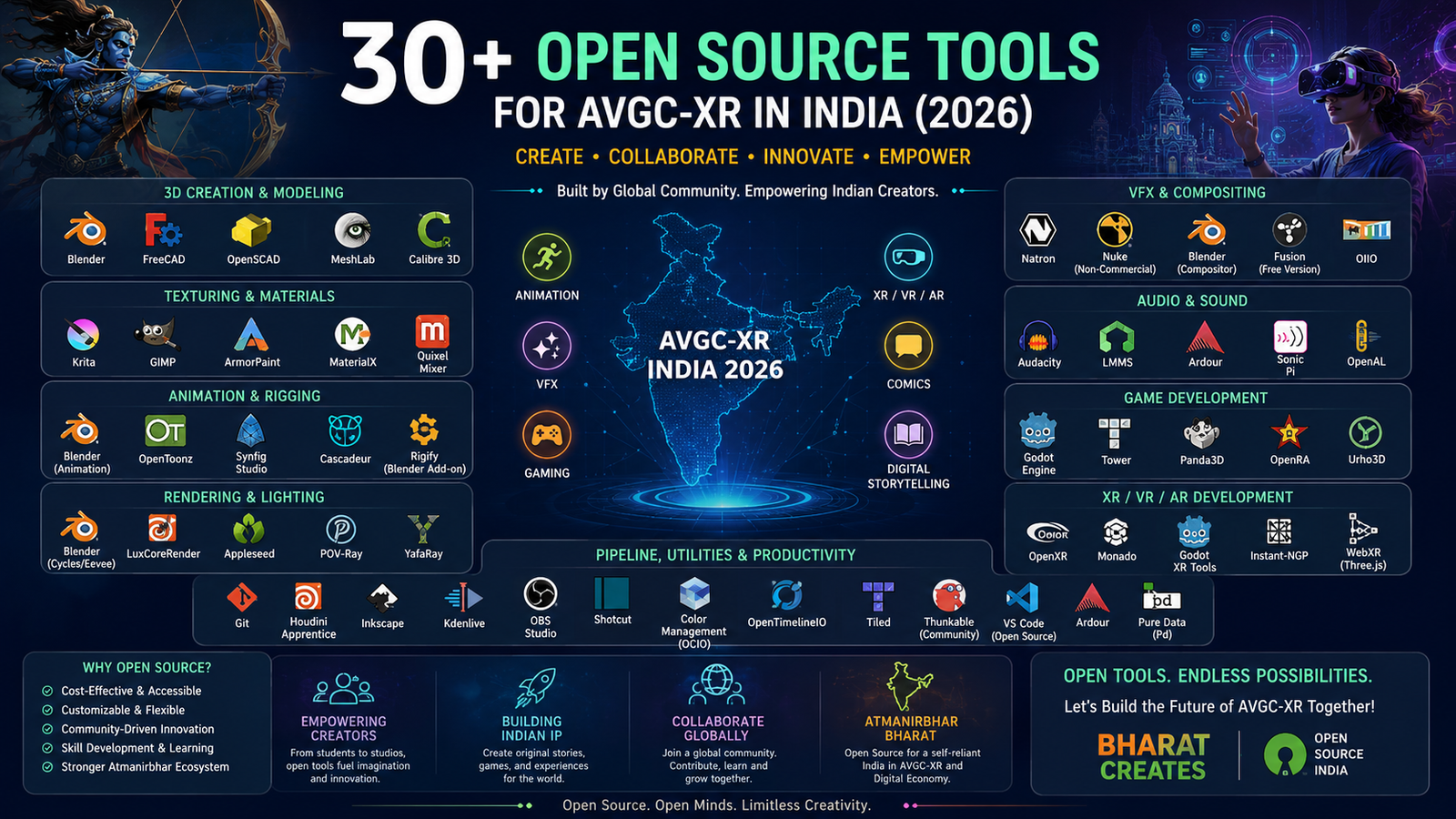
The complete list of open source tools for animation, VFX, gaming, XR, and pipeline management in India in 2026 — Blender, Godot, Kdenlive, and more.
30+ Open Source Tools Powering the AVGC-XR Industry in 2026
India's AVGC-XR sector is racing toward a $2.2 billion animation and VFX market by 2026, and a large part of that growth is being quietly powered by open source software. From indie studios in Pune to full-scale production pipelines in Delhi NCR, free and open-source tools are no longer "budget alternatives" — they're production-grade choices used alongside, and sometimes instead of, licensed software. This guide is the most complete round-up of open source tools across animation, VFX, texturing, video editing, audio, game development, XR, photogrammetry, and studio pipeline management — and what they mean for India's Orange Economy.
Why Open Source Tools Matter for AVGC-XR in India
Open source tools give studios, students, and independent creators zero-licensing-cost access to production-grade animation, VFX, and XR pipelines. In India, where the AVGC-XR sector is projected to create over 160,000 new jobs annually, this lowers the barrier to entry for talent and lets small studios compete globally without heavy software overhead.
For a country building toward the National AVGC-XR Mission's vision of a $40B AVGC economy by 2030, that's not a minor detail — it's a structural advantage. Open source tools mean skill development doesn't require expensive licenses, academic institutions can teach production-ready pipelines affordably, and studios can reinvest software savings into talent and infrastructure.
3D Animation, Modeling & Sculpting Tools
Blender has become the single most capable free and open source 3D tool available, combining modeling, sculpting, rigging, animation, simulation, compositing, and rendering in one package. Its animation toolset includes a dope sheet, graph editor, non-linear animation editor, inverse kinematics, and pose libraries — the same category of tools studios expect from paid 3D software. For game and XR pipelines specifically, Blender offers Rigify auto-rigging, FBX and glTF export for major engines, and direct "Send to Unreal" integration. Its Grease Pencil feature also enables 2D drawing and animation directly inside 3D scenes — a natural fit for the hybrid 2D/3D visual style trending across the industry this year. Blender also ships two render engines out of the box: Eevee for fast real-time previews and stylized work, and Cycles for physically based, photorealistic rendering.
Beyond Blender, a growing set of specialist open source 3D tools rounds out the modeling and asset pipeline:
- MakeHuman — An open source tool purpose-built for rapid, parametric human character generation, useful for pre-viz, background characters, or rigging bases.
- FreeCAD — A parametric 3D CAD modeler, useful for hard-surface and precision assets that need to cross over from engineering-style workflows into game or VFX pipelines.
- Inkscape — The standard open source vector editor, frequently used for UI/UX design, concept sketches, and 2D asset creation feeding into animation and game pipelines.
Where these fit: Full 3D production, character animation, motion graphics, hard-surface modeling, and game-ready asset creation — the core of most AVGC studio pipelines.
2D & Traditional Animation Tools
Not every AVGC-XR production is 3D. For traditional and 2D character animation, several open source tools dominate:
- Krita — Originally a digital painting tool, Krita's animation workspace includes a timeline, onion skinning, audio import, and export via FFmpeg. Especially strong for hand-drawn sprites, concept art, and expressive linework.
- OpenToonz — Offers the deepest studio-style 2D workflow of any free tool, closely mirroring the pipeline used by professional animation studios internationally.
- Tahoma2D — A community-developed fork focused on both 2D and stop-motion animation workflows.
- Synfig Studio — Built for vector-based animation with reusable rigs, ideal for explainer videos and lightweight character animation.
- Pencil2D — A lightweight, beginner-friendly tool for simple hand-drawn 2D animation, often used in training and academic settings to teach animation fundamentals.
- Storyboarder — A dedicated open source storyboard editor for pre-production planning before a single frame of final animation is made.
Where these fit: Traditional animation training programs, explainer content, storyboarding, and hybrid productions layering 2D characters over 3D environments.
VFX Compositing & Texturing Tools
- Natron — A powerful, free, node-based VFX compositing application built around industry-standard open technologies like OpenFX, OpenColorIO, and OpenImageIO, with over 100 nodes and support for community plugins. It's frequently compared to Nuke and Fusion for its node-based workflow, and pairs well with Blender for 3D-assisted compositing.
- Blender's built-in Compositor — A fully integrated node-based compositor inside Blender itself, letting solo artists and small studios handle color grading, effects, and object/camera tracking without leaving the application.
- ArmorPaint — A GPU-accelerated, open source PBR texturing tool supporting textures up to 16K resolution, layer-based and node-based workflows, and direct plugin export to Blender, Unreal Engine, and Unity — a genuine open source alternative to Substance Painter for game and VFX asset texturing.
- G'MIC — A full-featured open source framework for digital image processing, often used for custom filters and batch image effects in production pipelines.
Where these fit: VFX post-production, compositing, color grading, camera tracking, and PBR texture creation for game and film assets.
Video Editing & Audio Tools
Post-production and sound design also have mature open source options widely used across small and mid-size studios:
- Kdenlive — A full-featured, GPL-licensed non-linear video editor built on the MLT Framework, supporting multi-track editing, transitions, color grading, and full audio mixing.
- OpenShot — An award-winning, beginner-friendly free video editor available on Linux, Mac, and Windows.
- Olive — A non-linear video editor aiming to match high-end professional editing software feature-for-feature.
- Shotcut — A cross-platform, open source editor known for wide format support and a straightforward timeline workflow.
- Audacity — The most widely used open source audio editor, standard for dialogue cleanup, sound design, and voiceover editing.
- LMMS and Ardour — Open source digital audio workstations for music composition and multi-track audio production, useful for scoring game and animation projects in-house.
- OBS Studio — Free, open source software for screen capture, live streaming, and recording — widely used for game dev livestreams, dev logs, and remote review sessions.
Where these fit: Post-production editing, sound design, in-house scoring, and content operations around trailers, dev logs, and marketing video.
Game Engines & Interactive Development
Godot has moved from "indie engine" to a serious, MIT-licensed alternative to Unity and Unreal — with zero royalties and no revenue thresholds. Its OpenXR integration, developed with engineering support from the Khronos Group and Meta's Reality Labs, positions it as a genuine open-source path into VR and AR development. Recent releases have added full body tracking, mixed reality environment depth, and an XR Project Setup Wizard that gets export-ready XR projects running in minutes. Godot now deploys across Meta Quest, PICO, HTC, Samsung Galaxy XR, and SteamVR hardware through OpenXR, with only build-target changes required between platforms.
Other open source engines and frameworks worth knowing:
- O3DE (Open 3D Engine) — An Apache-2.0-licensed, AAA-capable game engine originally developed by Amazon and now governed by the Linux Foundation, aimed at studios that need a fully open, high-fidelity engine alternative.
- Ogre 3D — A mature, open source rendering engine widely used as a foundation layer inside custom game and simulation tools.
Where these fit: Game development, WebXR prototypes, and cross-platform VR/AR builds — particularly for studios and students who need engine-level flexibility without licensing costs.
Open Source XR & WebXR Frameworks
Beyond Godot, a broader open ecosystem supports XR development end to end, including entirely browser-based immersive experiences that need no app install:
- OpenXR (Khronos Group) — The cross-platform standard now supported by Meta Quest, SteamVR, PICO, HoloLens 2, and more, eliminating the need to build separately for each headset.
- A-Frame — A web framework for building 3D/AR/VR experiences using simple HTML markup and an entity-component system, widely used for rapid WebXR prototyping.
- Three.js — The foundational open source JavaScript 3D library that underpins much of the WebXR ecosystem, giving developers low-level control over rendering.
- Babylon.js — A free, open source 3D and rendering engine built on WebGL and WebGPU with native WebXR and Web Audio support, increasingly adopted for enterprise-grade browser-based immersive experiences.
- PlayCanvas — A web-first, open source game engine geared toward real-time 3D and WebXR content that runs instantly in the browser.
- AR.js — An accessible entry point for browser-based, markerless augmented reality experiences.
- LÖVR — A lightweight, Lua-based VR framework for research prototypes and experimental XR work.
- Godot XR Tools — A community-maintained library of AR/VR interaction scenes and support code for Godot-based XR projects.
Where these fit: Browser-based AR/VR demos, XR marketing campaigns, WebXR product visualization, and lightweight immersive experiences that don't require a native app download — a strong fit for B2B and consumer XR use cases in India.
Photogrammetry & Motion Capture Tools
Realistic assets and character motion no longer require expensive scanning rigs or mocap suits:
- Meshroom — An open source photogrammetry tool built on the AliceVision framework, transforming ordinary photographs into detailed 3D models using computer vision, useful for scanning real-world props, environments, or actors into game-ready assets.
- AliceVision — The underlying open source photogrammetric computer vision framework powering Meshroom and other reconstruction pipelines.
Where these fit: Environment scanning, realistic asset creation, and low-cost digitization workflows for game, film, and XR production.
Open Source Studio Pipeline & Production Tracking Tools
Beyond individual creative applications, a growing set of open source tools now manage entire studio pipelines — the layer that connects artists, software, and delivery schedules:
- AYON (formerly OpenPype) — An open source (Apache 2.0) pipeline platform connecting a studio's DCC tools, version tracking, and project management into one system. It integrates with Maya, Houdini, 3ds Max, Blender, Nuke, Unreal Engine, Substance Painter, and more, with out-of-the-box support for USD and real-time workflows. A free, self-hosted Community Edition is available permanently.
- Kitsu — An open source production tracker (by CGWire) built specifically for animation, VFX, and game studios, letting production managers set up assets and shots, assign tasks, and review deliverables — including images, movies, and OBJ files — directly in the browser.
- F3D — A fast, minimalist open source 3D viewer supporting thumbnails and a wide range of file formats, useful for quick asset review inside a pipeline.
- OpenTimelineIO — An open interchange format and API for editorial timeline data, helping studios move cut information cleanly between editing and VFX tools.
Where these fit: Studio-scale production tracking, asset versioning, and pipeline orchestration — the operational backbone that lets a studio scale from a five-person team to a hundred-person production without losing control of the schedule.
How to Get Started with Open Source AVGC-XR Tools in India
- Identify your production track — 3D animation and VFX, 2D/traditional animation, game development, or XR/immersive experiences each favor different tools.
- Start with Blender for 3D — It's the broadest single toolkit and integrates with nearly every downstream pipeline.
- Add Krita, OpenToonz, or Synfig for 2D — Especially useful in academic and training environments teaching foundational animation principles.
- Bring in Natron or ArmorPaint for finishing — Compositing and PBR texturing round out a full VFX and game-art pipeline.
- Move to Godot, Babylon.js, or A-Frame for interactive and XR work — Choose a native engine (Godot) for deep control, or a WebXR framework (Babylon.js, A-Frame) for browser-first, install-free experiences.
- Layer in OpenXR-based tools — For teams building AR/VR specifically, standardizing on OpenXR avoids vendor lock-in early.
- Add pipeline tooling once you scale — AYON and Kitsu become valuable the moment a studio grows beyond a handful of freelancers working informally.
- Pair open source tools with structured training — Software access alone doesn't build production skill; a mentored pipeline accelerates it significantly.
- Scale into hybrid pipelines — Most professional studios, including those in India, blend open source and commercial tools depending on client and project needs.
FAQ
Q: Are open source tools like Blender and Godot good enough for professional AVGC-XR production in India?
A: Yes. Blender is used for full 3D production, rigging, and rendering, while Godot now supports cross-platform XR development through OpenXR. Many Indian studios use them alongside commercial tools like Maya, Nuke, or Unreal depending on project scope.
Q: Which open source tool should students learn first for a career in animation or XR?
A: Blender is the strongest starting point for 3D animation and game-ready assets, while Godot or A-Frame are ideal for those focused on interactive game or XR development. All are free, well-documented, and industry-relevant in 2026.
Q: Do open source tools reduce the cost of building an AVGC-XR studio in India?
A: Significantly. Zero licensing costs across modeling, animation, compositing, editing, and even pipeline management (via tools like AYON's free Community Edition) mean studios can redirect budget toward talent, infrastructure, and training.
Q: Can open source XR tools work across different headsets like Meta Quest, PICO, and Samsung Galaxy XR?
A: Yes, through the OpenXR standard. Engines like Godot and frameworks like Babylon.js support OpenXR and WebXR natively, letting developers build once and deploy across multiple headset ecosystems with minimal changes.
Q: Is there an open source alternative to studio pipeline software like ShotGrid or ftrack?
A: Yes. AYON and Kitsu are open source production tracking and pipeline tools purpose-built for animation, VFX, and game studios, and both integrate with major commercial and open source DCC applications.
Ready to Build on the Right Pipeline?
Whether you're a studio evaluating your production stack, an institution designing an AVGC-XR curriculum, or a creator exploring XR for the first time, choosing the right mix of open source and commercial tools matters. AVGC XR Solutions works across production, training, academic partnerships, and research to help teams in India's Orange Economy build pipelines that scale — talk to our team to explore what fits your project.